Week 4: Geopolitics, a Fable as Old as Time
For eighteen days the US switched off Anthropic's most capable models for everyone outside America, then reversed it. What that reveals about AI, China and the geopolitics of who controls the frontier.

Rich Hay
Co-Founder
On this page
First, an Apology
This article is late, very late. About 4 weeks late.
In reality few will notice and fewer will care: Life gets pretty busy - both work and life can come at you in aggressive bursts, and sometimes, when it’s the weekend and you have a little time to spare, you really don’t feel like putting pen to paper (or more accurately, finger to keyboard). I have this weird downtime thing where I love watching YouTube channels of people living in rural America and building cool things with big tools. It takes all sorts and thank you “Ambition Strikes” for your work!
The good news is that a) It’s summer b) The weather is good c) The Kids have finished school, onto the next phase of their lives, exams willing, and d) I feel like collecting my thoughts and writing them down and sharing them.
In a way I am glad I was late, because in those 4 weeks A LOT has been happening in AI-land.
So What’s going on?
Quite a lot. Since 9 June the fifth generation of frontier models has arrived in pieces, and almost every piece has dragged a government along with it. Here is the whole run on one timeline, models and politics together, because this month the two stopped being separate stories.
%%{init: {"theme":"base","themeVariables":{"titleColor":"#ffffff","textColor":"#ffffff","cScale0":"#1f3a5f","cScaleLabel0":"#ffffff","cScale1":"#3f5d52","cScaleLabel1":"#ffffff","cScale2":"#1f3a5f","cScaleLabel2":"#ffffff","cScale3":"#3f5d52","cScaleLabel3":"#ffffff","cScale4":"#1f3a5f","cScaleLabel4":"#ffffff","cScale5":"#3f5d52","cScaleLabel5":"#ffffff","cScale6":"#1f3a5f","cScaleLabel6":"#ffffff","cScale7":"#3f5d52","cScaleLabel7":"#ffffff","cScale8":"#1f3a5f","cScaleLabel8":"#ffffff","cScale9":"#3f5d52","cScaleLabel9":"#ffffff"}}}%%
timeline
    title Six weeks in AI-land (9 Jun to 28 Jul 2026)
    28 May : Claude Opus 4.8 ships, the last Opus for a while (model)
    9 Jun : Anthropic launches Fable 5 and Mythos 5 (model)
    12 Jun : US Commerce export-control directive, both models dark worldwide in 90 min (policy)
    26 Jun : Order eased, Mythos 5 allowed to 100+ trusted US orgs, Fable still blocked (policy) : OpenAI ships GPT-5.6 to government-vetted partners only (model)
    30 Jun : Commerce withdraws the controls after a new 99 percent jailbreak classifier (policy) : Claude Sonnet 5 ships, near-Opus performance at half the price (model)
    1 Jul : Fable 5 restored worldwide, the 18-day blackout ends (model)
    9 Jul : GPT-5.6 opens to the public (model)
    16 Jul : Moonshot launches Kimi K3, a 2.8T open-weight model from China, a second DeepSeek shock (model)
    24 Jul : Anthropic launches Claude Opus 5, its fourth model in under two months (model)
    27 Jul : US weighs banning Chinese open-weight models, Amodei says he never asked for that (policy)
Two threads are worth pulling out of that.
The models. In seven weeks Anthropic shipped four frontier models: Fable 5 and Mythos 5 on 9 June, Sonnet 5 on 30 June, and Opus 5 on 24 July. OpenAI answered with GPT-5.6. Then came a shift from an unexpected direction: Moonshot AI’s Kimi K3, a 2.8-trillion-parameter open-weight model from China, landed on 16 July, undercut the American labs on price, and released its weights for anyone to download. The frontier is no longer only American, and no longer only closed.
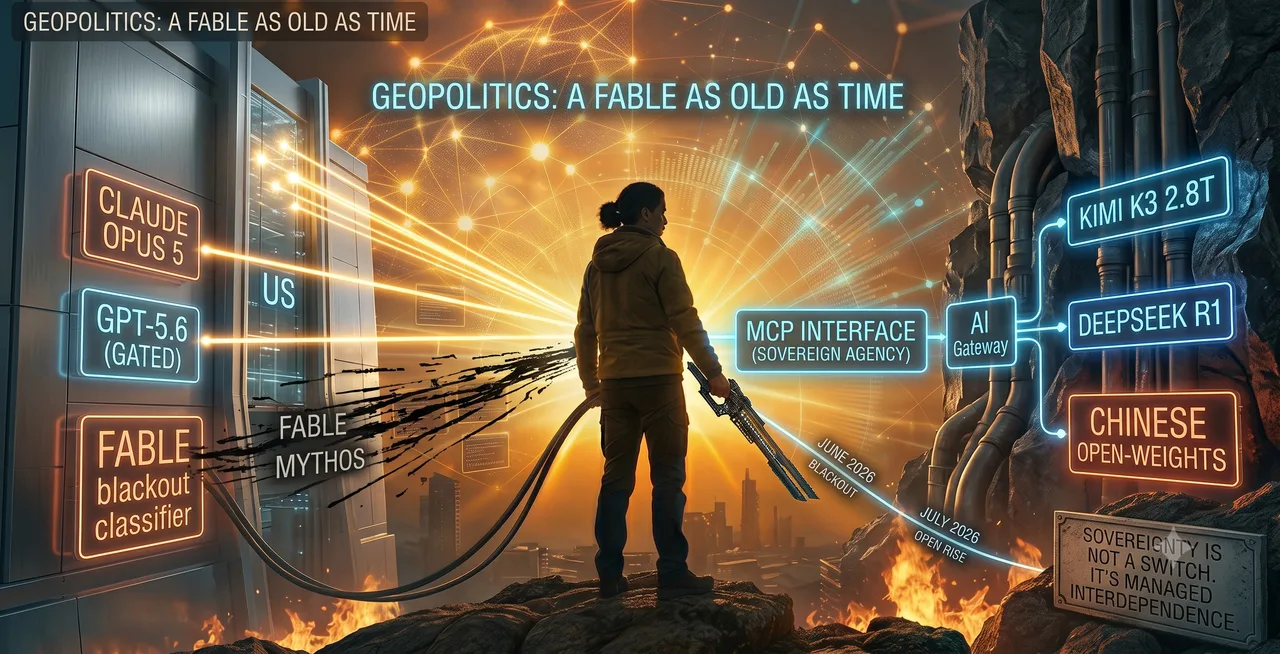
The geopolitics. On 12 June the US ordered Anthropic to block both models for any foreign national anywhere, including its own non-citizen employees, and with no way to comply selectively the company pulled Fable and Mythos worldwide within ninety minutes. The ban did not stick. After 18 days offline, the Commerce Department withdrew the order on 30 June, once Anthropic had built a classifier that blocks the flagged jailbreak more than 99 percent of the time and agreed to coordinate future releases with the government. The concession, not the ban, is the real story: access came back, but on the government’s terms. Then the argument inverted. By late July it was Washington weighing whether to block the cheap Chinese open-weight models, with Anthropic publicly denying it had ever asked for that.
Two things stand out from six weeks of this. A frontier model that hundreds of millions of people rely on can be switched off, and switched back on, by a single government in an afternoon. At the same time the supply of frontier capability is widening, with capable open-weight models coming out of China faster than most expected. Dependence and choice are increasing together, and that tension is what the rest of this article is about.
A month is a long time in AI-land
Wow, what a month and an awful lot to unpack, a lot of spin, a lot of opinions so what is going on?
To make sense of a single month you have to back up about twenty-five years, because none of this started in June 2026. It started in December 2001, when China joined the World Trade Organisation.
What followed is the most compressed industrial rise in history. China began at the bottom of the value chain, the place where other people’s products were assembled for other people’s brands. Designed in California, made in Shenzhen. The deal was simple: access to the world’s largest workforce, and in time its largest market, in exchange for the technology that came with it. Foreign firms handed over know-how as the price of entry, and China learned. Then it moved up. Solar panels, high-speed rail, telecoms kit, batteries, electric cars, drones: one industry after another the West assumed it would keep, and one after another China learned to build better and cheaper. By 2015 the ambition was written down as “Made in China 2025”, a plan to lead in the high-value industries of the century, semiconductors and AI among them.
The method remained the same. Take a technology someone else invented, work out how to make it for a fraction of the cost, produce it at a scale nobody can match, and move up a rung or ten. Call it copying if you like, but it is closer to distillation: absorb the essence of something expensive and reproduce it cheaply.
That word is worth holding onto, because it is exactly what happened to AI. In January 2025 a Chinese lab called DeepSeek released a model, R1, roughly as capable as the American frontier at a fraction of the training cost. The market understood the implication in a day: Nvidia lost about $589 billion of value on 27 January, the largest single-day fall for any company on record. OpenAI’s complaint was pointed. DeepSeek, it said, had used distillation, training its cheaper model on the outputs of more expensive American ones. The same move as the solar panels and the high-speed rail, in software. This July it happened again with Moonshot’s Kimi K3, only this time the model was given away as open weights.
America has spent a decade trying to stop precisely this. First tariffs, from 2018. Then the real lever: compute. From October 2022 the US restricted the export of the most advanced chips and the machines that make them, on a simple theory, that you cannot train a frontier model without a great deal of cutting-edge silicon and almost all of it passes through American hands. Add the entity lists, the pressure on allies to fall in line, and the money to rebuild chip fabrication at home. The strategy even has a name, “small yard, high fence”: wall off the few things that matter most, let the rest trade freely. In 2026 the wall reached the models themselves. The Fable and Mythos directive, the gated release of GPT-5.6, the talk of banning Chinese open-weight models: the frontier is now treated as a controlled export, like enriched uranium or a fighter jet.
Here is where I show my hand. Two contests are running at once, and it suits some people to blur them. The first is an obvious reality: the United States and China competing for the defining technology of the age, with genuine security stakes on both sides. The second is quieter. A handful of American hyperscalers are using the first contest as cover to corner the second. They already own the compute, the cloud it runs on, the custom chips inside it, and the models on top, most of them closed. Cheap open-weight models, especially Chinese ones, are the main threat to that position, because they hand capability to everyone for almost nothing. So “keep it out of China’s hands” and “keep it inside ours” happen to point the same way, which is convenient if you are one of the four or five firms that would own the result.
I think concentrating this much power in so few companies is the greater long-term risk, and it does not become safe just because it is dressed as security. The China concern is legitimate. But locking the technology behind a small number of American gates and charging rent for the key is not the only answer, and it is a very good deal for the gatekeepers. That is the board this month was played on: two superpowers, a few superscalers, all trying to own the same thing.
The question the rest of the world is now asking
If you’re not American, the Fable episode is not a story about Anthropic. It’s a story about ‘us’.
Because the thing that was switched off wasn’t switched off in America. American users, by and large, kept their access. The people who lost it were everyone else: foreign nationals, foreign companies, foreign public services that had quietly wired a US frontier model into how they operate. The dependency that felt like a commercial relationship turned out, overnight, to be a geopolitical one.
The reaction came fast. In the UK, the House of Lords was asking within days whether our dependence on US technology in health, education and security had become a national security vulnerability in its own right. The government’s answer leaned on a phrase you’re going to hear a great deal more of: sovereign AI. The Open Rights Group had already been warning, months earlier, that hyperscale cloud (AWS, Azure) is ultimately bound by US law, which means US authorities can reach data held on UK soil, or pull a service, by order. Fable made the abstract warning concrete.
Analysts reached for the same vocabulary. Gartner started telling boards to treat model concentration risk as a first-class concern and to design model-agnostic architectures. The German Marshall Fund’s Sharinee Jagtiani put it more bluntly: “technological dependencies can be weaponised,” and the era when you could assume otherwise (built, as she said, on “relative geopolitical stability and a baseline assumption of trust”) is over. Her prescription wasn’t to cut the US off. It was managed interdependence: a diverse supplier base, deeper ties with “technology middle powers” like Canada, Japan, South Korea, Australia and India, and never again betting the operation on a single supplier.
None of this is new thinking. Whoever controls the thing everyone else depends on has leverage, and that is the oldest move in geopolitics, run before with grain, oil, sea lanes and semiconductors, and now with models. What is new is the speed: the gap between “this is fine” and “we have a problem” was about ninety minutes.
This is the point of this series - just through a Geopolitical lens
I’ve been writing this series for four weeks now, and the uncomfortable thing about the Fable episode is that it’s the same argument I’ve been making about a small consultancy, just played out at the scale of nations.
Article 1 was about a handful of giants pouring hundreds of billions into building intelligence itself. Article 3 and Article 4 were about owning your data layer and refusing to let your operation be siloed inside a vendor you don’t control. I framed all of that as economics: cost, speed, control. Fable reframes it as something older and harder: sovereignty. The reason to own your stack isn’t only that renting got expensive. It’s that the controls should be yours.
“Design model-agnostic architectures” is consultant-speak for the most ordinary survival instinct there is. Don’t depend on one supplier.
The honest bit
Here’s where I have to be straight, because it would be easy to write a triumphant “and that’s why we own everything” paragraph and it would be a lie.
We can’t fully exit, and neither can you. Bigspark runs on AWS, which is to say, on the exact dependency the Open Rights Group is warning about. Most of the best frontier models are American. The chips underneath all of it trace back through a supply chain that runs through Taiwan and a small number of US firms. Anyone telling you they’ve achieved “AI sovereignty” as a small business is selling something. Sovereignty isn’t a switch you can flip. It’s a spectrum, and honestly it’s managed interdependence all the way down, exactly as Jagtiani said.
What you can do is refuse the single point of failure. You can make the model swappable. That’s the difference between actual resilience and theatrical resilience, and it’s the only version of this that’s available to a company our size.
A brief update from Bigspark 🔧
So, concretely, what have we actually done about it, not in response to Fable specifically, but as a direction we’d already been walking:
- Model-agnostic by default. Our agents talk to models through a common interface (LiteLLM + MLflow packaged into an AI gateway), with bounded loops and multiple models in play. Swapping a provider is a config change, not a rewrite. If a model goes dark on a Friday evening, the work doesn’t stop.
- We own the knowledge layer. Our GAAARS knowledge bases are just markdown and embeddings in git: versioned, diffable, ours. No vendor sits between our agents and our own knowledge.
- We killed the SaaS silos. As I wrote in my last article, our docs have moved out of Confluence and into git as plain markdown, readable by a person and an agent alike. This week that included writing our own onboarding and device-setup guides as part of standardising the business on Google Workspace, with enforced 2-Step Verification and Google Credential Provider for Windows so identity is owned and consistent rather than scattered.
- The MCP interface is the insurance policy. Because every tool and knowledge base exposes the same interface, the backend behind it (git, a database, one model or another) can change without the agents noticing. That indifference is the sovereignty. It’s the controls being ours.
It’s not independence. We still rely on infrastructure and models we don’t own. But we’ve made sure that no single one of them can switch us off.
What’s next
We are dangerously close to real “Agentic Development” - right now we have human ‘jockeys’ (Formerly Known as ‘Developers’) rapidly riding change through agentic harnesses such as Kiro:
- We have had to build a lot to get to this point: AI Gateways, Developer workspaces, knowledge bases, composable context and an internal portal acting as a control centre. This work on the foundation is largely complete.
- I am incredibly proud of the team that has helped to achieve this!
- I hope that in the next week or two we are producing code, sub-modules, modules, applications and ultimately product in controlled agentic loops/workflows: from idea to release the agentic way.
- At least initially, this agentic delivery will be run over relatively simple and straightforward change items. Over time, and with continuous learning and improvement I am sure we will be delivering high quality large scale change over complex systems and architectures. Knowledge has a habit of compounding if it is structured in the right way!
One more thing…
Friday evenings are always a little slow in the Hay house. Whilst watching Ambition Strikes or Veritasium or numerous other YouTube channels I have become accustomed to watching, I have been building lots of interesting, and some would say irrelevant, ‘things’ on our website.
Yes this is an SEO hack to drive some traffic through, but actually I am really happy with what Kiro-san and I have produced here, so please head over and take a look:
- bigspark.ai/learn - Learn about AI and how it works with lots of subject areas and demos
- bigspark.ai/playground - An absolute time sink and some of my favourite nerd oddities that have accumulated in my mind over the years
Article 5 in a series documenting bigspark’s AI-native transformation. Article 1: Staff Augmentation Is Dead. Article 2: Measure Twice, Build Once. Article 3: Knowledge is Power. Article 4: The SaaSpocalypse.